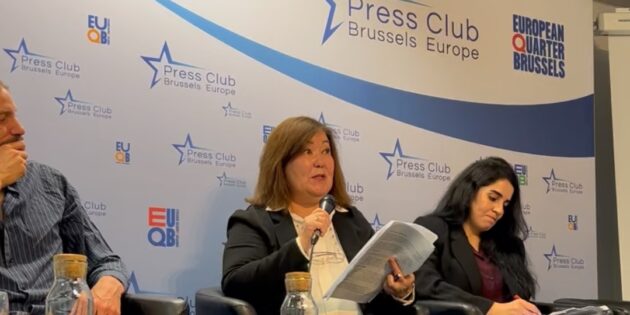
Kaisha Atakhanova Photo: WECF
The European Commission invited some 1000 participants to the 2nd Global Gateway Forum on 9-10 October 2025 in Brussels including Heads of State, Business leaders, Development Bankers and Civil Society representatives. The Global Gateway was launched as the joint investment program 4 years ago for partner countries in global South, totalling 306 billion Euro so far in investments being implemented by banks and businesses from European Member States and supported by guarantees from the European Commission.
Ensure highest human rights and environmental standards
With partner Kaisha Atakhanova of non-governmental organisation ARGO Kazakhstan, our director Sascha Gabizon participated in the forum, as a representative of the «Global Gateway CSO and Local Authority Advisory Platform». Kaisha Atakhanova spoke at the press event organised by CONCORD and Eurodad where she told the press that «we have seen in the recent past that investments in mining and energy have often harmed local communities, pollution water, land and food. The Global Gateway investments must prove their value by applying the highest European standards of environmental protection and social responsibility — in every project, in every community».
Focus on local jobs and rule of law
The president of the European Commission, Ursula von der Leyen, stated that GG project result in «resilient value chains that are built with a local perspective: with local jobs, local skills and local industries», which was echoed by a number of Heads of State, including from DRC and Grenada. President of South Africa, Cyril Ramaphosa, also warned that Global Gateway investment should not worsen the debt crisis. The Commissioner for International Partnerships, Jozef Sikela, stated: «the rule of law is central to how I see the world — I am an economist more than a politician. We live in a decade marked by recession, crises, the pandemic and war — many extraordinary events have affected global economic growth. Yet there is one essential element we must not overlook: climate change. In the Global Gateway, the fight against climate change and the rule of law, stand at the very top of our priorities». However, in particular in extractive and energy sectors, we continue to see a disconnect between guidance principles and the reality in communities.
Ensure access to justice and meaningful public participation
As ecofeminist organisations we are convinced more should and can be done by the actors in Global Gateway programs to ensure that environment and human rights are protected and investment contribute to local jobs and sustainable development. Kaisha Atakhanova says the Global Gateway should «respect the Aarhus Convention on access to environmental justice, transparency of information and the right to public participation in Global Gateway projects from design to result monitoring, and should apply ESG (Environmental Social Governance) standards — transparency is NOT optional».
Ensure transparency and hold polluters accountable
The problem we see is that many investors benefit from secrecy in contracting, and thus a lack of public scrutiny. The public requires access to information regarding the environmental impacts for all Global Gateway projects. Sascha Gabizon in her intervention during the last session called for key parts of the investment contract to be made public, in particular which actors are responsible in case of pollution and health impacts, who cleans up (toxic) tailings and waste, and what access to justice and reparation for local communities are ensured.
Targets for gender equality and women’s leadership
Sascha Gabizon furthermore recommended that cooperative and women-led social businesses should be included through a mechanism that will bridge the gap between local investment needs that are far lower than the minimum loans and guarantees available through the Global Gateway, here the application of the Gender Action Plan III, and blended funding from civil society (grants) and social impact hubs (equity) can play a role.
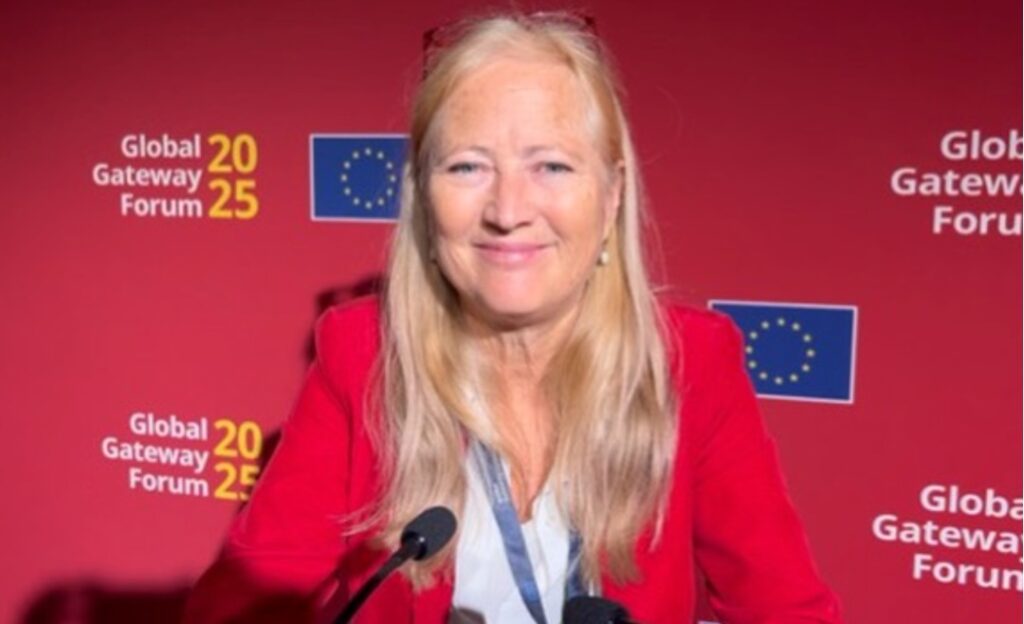
Sascha Gabizon Photo: WECF