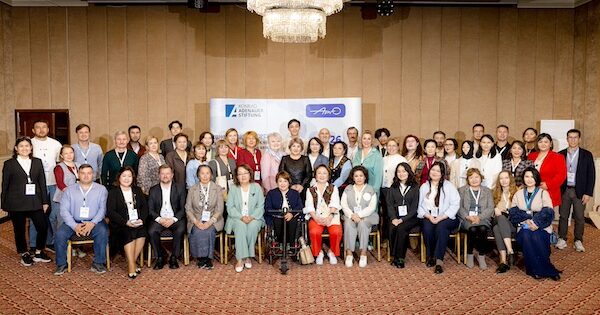
On September 26, 2025, Almaty hosted the foresight conference “Civil Society of Kazakhstan: An Analytical Look into the Future.”
The conference was organized by the Civil Society Development Association — ARGO in partnership with the Konrad-Adenauer-Stiftung e.V. Foundation Office in Kazakhstan.
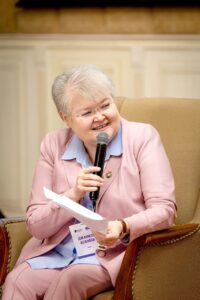 The goal of the conference was to develop a shared vision for the next 3–5 years and to identify strategic priorities for Kazakhstan’s civil society.
The event brought together leaders of non-profit organizations from the regions, representatives of government bodies, and experts and analysts from Astana and Almaty.
The format involved a step-by-step exploration of the topic: after the opening session, a panel discussion was held on the state and prospects of civil society, followed by foresight sessions that analyzed the current situation, discussed the outlook, and selected priority directions.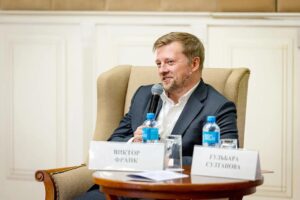
In her remarks, Gulbara Sultanova, Chair of the Committee for Civil Society Affairs of the Ministry of Culture and Information of the Republic of Kazakhstan, emphasized: “There are conditions for the development of civil society in Kazakhstan, but it cannot yet be called mature. There is room to grow.”
According to Ms. Sultanova, a more flexible system of state social contracting and careful work with public councils are needed. “We see low public engagement, a shortage of young leaders, and dependence on external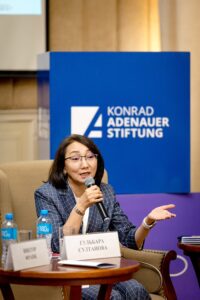 funding. Work needs to be done together and in a coordinated way,” she noted.
Lyazzat Kaltaeva, Adviser to the Speaker of the Senate and Chair of the Council on Inclusion under the Senate of the Parliament of the Republic of Kazakhstan, pointed to an important trend: “Today, opinion is shaped not only by NGOs. Bloggers, public authors, and sometimes even the stand-up scene are also part of civil society.” The breadth of the concept of “civil society” was also addressed by Yevgeny Zhovtis, Director of the Kazakhstan International Bureau for Human Rights and Rule of Law: “First of all, we need to clarify the terms. 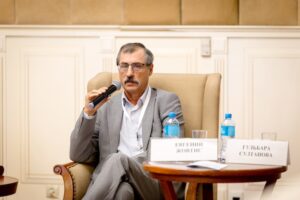
Civil society is not only NGOs. It is a broader concept: people, initiatives, forms of self-organization, relationships. It is the active part of society as a whole, including informal associations. The key word here is ‘civil’—the sense of oneself as a person who has influence over what happens around.”
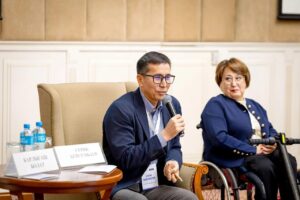 Serik Beysembayev, Director of the PaperLab Research Center, presented preliminary results of a survey of 72 organizations on the new draft law regulating NGO activities. He noted that awareness of the document was high, yet many NGOs opposed it, believing the sector is already heavily regulated and that new provisions would be seen as increased state control. “For many, this is not a step forward but a warning signal,” he said, adding that any change in the rules should be preceded by analytical work to understand the sector’s real needs and the potential consequences of such decisions.
The foresight sessions formed the practical part of the day. Participants first reviewed the current situation and agreed on common benchmarks for the next 3–5 years, then moved on to scenarios and the selection of priorities.
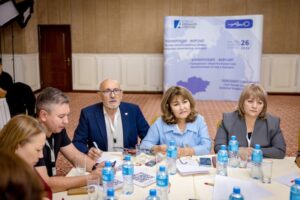
In the afternoon, discussions focused on applied solutions: organizational resilience under limited funding, new models of interaction with government, business, and citizens, support for social initiatives and social entrepreneurship, participation in SDG monitoring, and youth engagement.
Following the discussions, the groups formulated proposals and compiled them into a set of recommendations that will guide further work.